
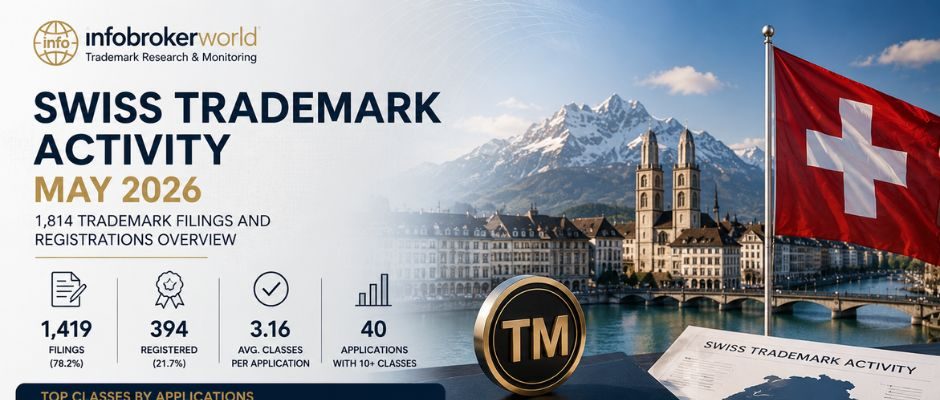
Switzerland sits outside the EU. That one fact changes everything about trademark strategy for any business selling there – because a European Union trademark registered at the EUIPO offers zero protection on Swiss soil. A separate filing with the IGE (Institut für Geistiges Eigentum) in Bern is the only way in. In May 2026, 1,814 applicants and companies acted on exactly that – and the data tells a revealing story about who is protecting what, and why.
This analysis by infobrokerworld.com breaks down the key figures, sector patterns and standout filings from the Swiss register in May 2026.
May 2026 at a Glance
| Metric | Value |
|---|---|
| Total entries | 1,814 |
| New filings (Filed) | 1,419 (78.2 %) |
| Completed registrations | 394 (21.7 %) |
| Lapsed / ended | 1 |
| Average Nice classes per filing | 3.16 |
| Filings with 10 or more classes | 40 |
The 21.7 % registration rate is notably higher than in the Nordic registers for the same month (12.4 %) – suggesting the IGE processes and publishes completed registrations with relatively little delay. Worth noting for monitoring purposes: filing date determines priority, not registration date. By the time a mark shows as “Registered”, the priority clock has already been ticking for months.
What Gets Filed: Trademark Types
Word marks account for 62 % of all filings – the dominant form across virtually every major register in Europe. They offer the widest scope of protection and are the most practical to enforce internationally. Combined marks (word plus figurative element) are the natural second choice for brands with a developed visual identity. Pure figurative marks, 3D marks and position marks together account for less than 5 %.
| Trademark Type | Count | Share |
|---|---|---|
| Word mark | 1,125 | 62.0 % |
| Combined mark (word + figurative) | 614 | 33.8 % |
| Figurative mark | 73 | 4.0 % |
| 3D mark | 1 | 0.1 % |
| Position mark | 1 | 0.1 % |
| Total | 1,814 | 100 % |
Who Filed the Most: Top 15 Applicants
The leaderboard for May 2026 is unusually varied – a U.S. construction materials group, a Swiss payments processor, a tobacco giant, a stablecoin issuer and several private individuals all feature in the top 15. The mix reflects Switzerland’s role as both a global business hub and a competitive domestic market.
| Rank | Applicant | Entries |
|---|---|---|
| 1 | Owens Corning Intellectual Capital, LLC (USA) | 14 |
| 2 | Philip Morris Products S.A. | 11 |
| 2 | Viseca Payment Services AG | 11 |
| 4 | Joe Zuppiger | 10 |
| 4 | BIOGENA S.R.L. | 10 |
| 4 | Andri Luzio | 10 |
| 7 | SYNGENTA CROP PROTECTION AG | 9 |
| 8 | Tether Operations, S.A. de C.V. (MX) | 8 |
| 8 | NIKE Innovate C.V. (NL) | 8 |
| 8 | Angro Brands B.V. | 8 |
| 11 | Raphael Fürer | 6 |
| 11 | Institut de formulation des vaccins (CH) SA | 6 |
| 11 | NH Properties Sàrl / MAPISOLA Sàrl / Atina Stone SA | 6 |
| 11 | Centravo Holding AG | 6 |
| 11 | Sissaoui Sidney Mehdi Joseph | 6 |
Four Stories Behind the Numbers
Owens Corning leads – again. The U.S. building materials group topped the Swiss register in May and the Nordic registers in the same month. All filings relate to the same core marks: „OC”, „OWENS CORNING” and the slogan „BUILD BETTER. ACHIEVE MORE.” – a textbook example of coordinated pan-European brand lockdown.
Private individuals with portfolio strategies. Joe Zuppiger filed ten variations of the „mainpoint” brand in a single month – from „mainpoint Alarmzentrale” to „mainpoint Verkehrsdienst” – covering an entire service portfolio in one sweep. This approach, protecting a core mark across all relevant descriptive combinations, is increasingly common among entrepreneurs building scalable service businesses.
Crypto secures Swiss footing. Tether Operations – issuer of USDT, the world’s most widely used stablecoin – filed eight marks with the IGE. Switzerland’s crypto-friendly regulatory environment makes it a natural jurisdiction for systematic brand protection in the digital assets space.
Tobacco files quietly, consistently. Philip Morris Products S.A. (11 entries) and Nicoventures (British American Tobacco) are both active in the May dataset. Despite tightening regulations across Europe, both companies continue to file new marks systematically – a reminder that regulated industries can be among the most disciplined trademark filers.
Nice Class Rankings: Services Lead, Tech Dominates
The top four Nice classes are all service categories – a clear reflection of Switzerland’s service-driven economy. Class 42 (IT and software development) ranks second, ahead of Class 9 (technology hardware and software products), which is unusual compared to most other European registers where Class 9 typically outranks 42. It signals that Swiss filers are particularly focused on protecting service-layer IP, not just products.
| Rank | Nice Class | Description | Mentions |
|---|---|---|---|
| 1 | Class 35 | Advertising, business management, retail | 700 |
| 2 | Class 42 | Scientific services, IT, software development | 582 |
| 3 | Class 9 | Technology, software, electronics | 553 |
| 4 | Class 41 | Education, entertainment, sport, culture | 507 |
| 5 | Class 25 | Clothing, footwear, headgear | 255 |
| 6 | Class 36 | Financial services, insurance, real estate | 208 |
| 7 | Class 16 | Paper, printed matter, stationery | 188 |
| 8 | Class 5 | Pharmaceuticals, medical preparations | 179 |
| 9 | Class 44 | Medical and veterinary services | 162 |
| 10 | Class 43 | Food services, accommodation | 155 |
Filings Worth a Second Look
Munich Files „Wiesn” Across 28 Nice Classes
The single broadest filing of the month came from an unexpected source: the City of Munich registered the trademark „Wiesn” – the colloquial name for Oktoberfest – with 28 Nice classes at the IGE. That covers virtually every conceivable product and service category, from food and clothing to financial products. Since Switzerland is not part of the EU, German or EU-wide trademark protection does not extend here. Munich’s decision to file separately is strategically sound – and signals how seriously the city manages its most valuable cultural brand asset internationally.
Centravo: 23 Classes, Twice
Swiss recycling and circular economy company Centravo Holding AG filed multiple marks at 23 Nice classes each, including „swiss ecovalor” and „swiss nutrivalor”. Filing this broadly – well beyond any single product or service line – suggests a deliberate strategy to pre-empt competitors across adjacent categories and lock in a wide perimeter of protection for a growing brand family.
AI Branding: At Least 17 Marks, Probably More
May 2026 confirms what has been building for the past two years: AI-branded trademarks are now a measurable filing category in their own right. At least 17 entries in the Swiss dataset carry an explicit AI reference in the mark name – through the abbreviation „AI”, the domain extension „.ai”, or direct naming conventions. Examples include 360supply.ai (supply chain software), aicore (digital services), Aikonic (software and digital content), AIME covering 18 Nice classes, and OpenSesame AI inc. – already registered. The real number is likely higher once marks describing AI-driven concepts without using the abbreviation are included.
Global Names in a Local Register
Roughly 10 % of May’s filings came from clearly international companies. The list includes Microsoft, Nike, Hyundai Motor, Bridgestone, FIFA, Calendly and Playboy Enterprises – a cross-section of industries that underlines one consistent truth: for any global brand, Switzerland demands its own trademark strategy. The IGE register is not a footnote to an EU filing – it is a standalone jurisdiction that requires standalone protection.
What the Swiss Trademark Data Means for Your Business
Five takeaways from the May 2026 IGE dataset that apply beyond the statistics:
- Switzerland is not covered by your EU trademark. If you hold an EUIPO registration and operate in Switzerland without a separate IGE filing, your brand is unprotected there – regardless of how broad your EU coverage is.
- Watch filings, not just registrations. Priority runs from the filing date. Monitoring only completed registrations means you are always months behind the actual competitive landscape.
- AI branding is accelerating. Seventeen-plus AI-branded marks in a single month in a single country is a signal. If your sector is digital or tech-adjacent, the competitive naming space is narrowing fast.
- Broad class coverage is becoming standard practice. The average filing in May covered 3.16 classes. Forty filings covered ten or more. Protecting a mark in one or two classes may leave significant gaps.
- Private filers are as strategic as corporations. The appearance of individuals with ten-mark filing campaigns in a single month shows that sophisticated brand portfolio thinking is no longer limited to legal departments of large companies.
Source: IGE – Institut für Geistiges Eigentum, Bern | Data: May 2026 | Analysis: infobrokerworld.com
? Operating in Switzerland and not sure your trademark is covered? See how we monitor the IGE register for you ?


