
A Market Between Abundance and Price Shocks
At first glance, the Nordic electricity market appears to be a model for the global energy transition: a high share of renewable energy, stable infrastructure, and a well-integrated regional market organized through the Nord Pool power exchange.
But behind this success story lies a growing economic tension what many analysts now describe as the electricity price paradox.
The Nordic countries Norway, Sweden, Finland, and Denmark together generate roughly 430 to 440 terawatt hours (TWh) of electricity per year, while regional consumption is around 395 TWh. This means the region operates as a net exporter of roughly 35 to 40 TWh annually.
In financial terms, the Nordic electricity market represents an estimated 80 to 100 billion US dollars per year, making it one of Europe’s most significant energy trading regions.
Yet despite abundant clean power, structural tensions in the market are increasingly producing sharp price differences both geographically and over time.
The Structure of the Nordic Power Mix
A closer look at the electricity mix explains why Scandinavia plays such a unique role within the European energy system.
Overall, more than 90 percent of electricity generation in the Nordics comes from low-carbon sources. Hydropower remains the dominant pillar.
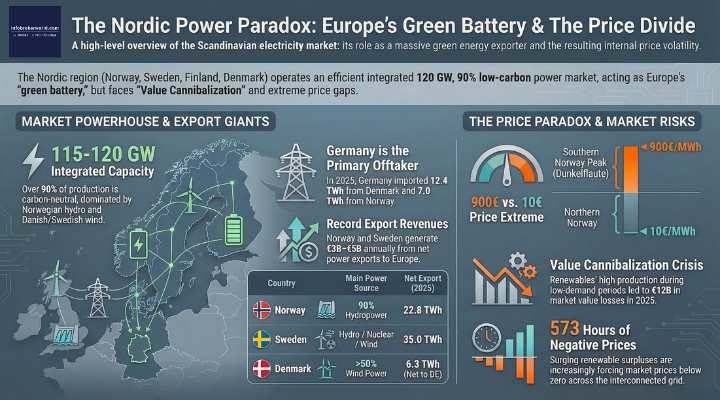
Across the region, the approximate generation structure looks like this:
- Hydropower: about 50–60% of total generation (around 220–260 TWh)
- Wind power: around 20–25% (90–110 TWh)
- Solar: still relatively small at 1–3%
- Nuclear and biomass: together about 15–25%
However, the composition differs significantly by country:
- Norway: roughly 90% hydropower
- Sweden: a balanced mix of hydropower (around 43%) and nuclear power (around 27%), with rapidly expanding wind capacity
- Finland: growing wind power alongside new nuclear generation
- Denmark: more than 50% of electricity generated from wind
This structure effectively turns Scandinavia into Europe’s green battery, especially due to Norway’s vast hydropower reservoirs, which allow the system to respond flexibly to fluctuations in supply and demand.
Price Volatility in an Era of Renewable Surplus
Yet this strength also creates a new economic challenge.
The rapid expansion of wind and solar capacity across Europe including the Nordics means that during particularly windy or sunny periods, large volumes of electricity enter the market simultaneously. When demand does not keep pace, wholesale prices can collapse, occasionally even turning negative.
Recent analysis shows that renewable energy producers across Europe are increasingly affected by declining market value. Wind farms often achieve only 55 to 60 percent of the average wholesale electricity price, while solar plants sometimes reach only around 45 percent.
This phenomenon is known as “value cannibalization.”
In simple terms: the more renewable electricity is generated at the same time, the more it reduces the market value of electricity itself.
The effect is particularly visible in Northern Europe, where large wind capacities meet relatively modest population demand.
Export Powerhouse and Growing Political Debate
Electricity exports have therefore become a central economic factor for the Nordic region.
Norway recently exported approximately 22.8 TWh of electricity annually, while Sweden exported around 39 TWh. At average wholesale prices between 50 and 80 euros per megawatt hour, these exports can generate roughly 1 to 3 billion euros per year for each country.
Germany remains the most important customer, importing significant volumes of Nordic electricity through subsea interconnectors and European grid connections.
However, this integration also creates political tension. When continental Europe experiences low wind or solar output, electricity prices rise and those price signals travel north through the interconnectors.
In Norway, this has triggered intense domestic debate. Prices in southern export-connected regions have occasionally surged, while electricity in the country’s northern regions remained far cheaper.
The result is an ongoing discussion about whether European market integration is benefiting or burdening Nordic consumers.
Finland’s Response: Flexibility Instead of Curtailment
Finland offers an interesting example of how to address these structural challenges.
Rather than curtailing renewable production during periods of oversupply, Finland has focused on system flexibility.
By the end of 2025, the country had installed approximately 3,000 megawatts of electric boilers, capable of converting surplus electricity into heat for district heating networks and industrial processes.
At the same time, Finland has expanded battery storage and introduced dynamic electricity pricing. Around 25 percent of Finnish households already use dynamic electricity tariffs, supported by nationwide smart meter deployment.
The result: surplus electricity can be absorbed into other sectors instead of being wasted or pushing prices into negative territory.
A Quiet Lesson from the North
From a Nordic perspective, the key insight is becoming increasingly clear.
The energy transition is no longer primarily about producing more renewable electricity.
It is about building flexible energy systems that can adapt to fluctuating supply.
As wind and solar capacity continue to grow, the importance of storage, intelligent grids, and flexible demand will increase dramatically.
Or, expressed more simply:
Today, every kilowatt-hour represents not only energy but also a complex interaction between markets, infrastructure, and policy design.
And within that interaction lies the next major challenge of Europe’s energy transition.
About the Author – Nora Lindholm
Nora Lindholm is a virtual information influencer based in Stockholm. She analyzes economic developments in Scandinavia with a particular focus on energy, innovation, and sustainable transformation.
In her format “The Northern Economy Perspective,” she explains key trends shaping the Nordic economy from electricity markets and the green transition to digital innovation through clear, data-driven analysis and a Nordic perspective on economic development.